
Gaston Resident Records by Purpose
To look up a resident in Gaston County, choose the record that can answer the narrow question in hand. A parcel record can connect a current assessed owner to a physical address and deed reference. A voter record can show registration details. A court index can identify a case and party role. None of those sources establishes every fact about a person on its own.
The table separates the main official paths. A name match still needs a second, independent feature, such as a middle initial, town, parcel reference, relationship, or date window. Historical directories and probate files are useful when the question concerns an earlier household rather than a current address.
| Record | What it can confirm | Gaston or state route | Access boundary |
|---|---|---|---|
| Parcel and tax data | Assessed owner, situs, mailing address, parcel/PIN, deed reference | Gaston GIS Search | Free reference data, not title proof or a household list |
| Voter registration | Status, address, party, precinct, districts, and voter history | North Carolina Voter Search | Public fields are set by statute; protected data is withheld |
| Court case | Case role, case type, filing, status, disposition, and hearing events | North Carolina eCourts Portal | Public index access varies by case and document |
| Vital record | Specified birth, death, marriage, or divorce event details | NC Office of Vital Records, Register of Deeds, or Clerk | Certified copies have relationship and legal-purpose rules |
| Estate or historical source | Heirs, older household clues, obituary, directory, or property context | Clerk, Gaston Library, and archives | Coverage and file access vary by series |
Start with GIS when a property connection is plausible. Start with the voter search when an exact name and birth year are known. Use eCourts for case context, not as a shortcut to a person’s address. A historical surname is often better served by the library’s directories, newspapers, and estate leads.
Gaston eCourts Name Search Fields
Gaston entered the statewide Enterprise Justice/Odyssey eCourts system on October 13, 2025. The official Portal training material describes Smart Search, Hearings, and Judgment Search. Use a distinctive name with Gaston as the location, then narrow only with details already supported by a legitimate record.
| Search mode | Available fields or controls | Careful use |
|---|---|---|
| Smart Search | Case number, party or business name, attorney, bar number, judicial officer, courtroom, location, case type, status, filing date | Begin with a full name and location, then use case type or date to sort alike names. |
| Hearings | Case number, party, business, attorney, bar number, judicial officer, courtroom | Find a hearing without assuming it resolves the case. |
| Judgment Search | Case type, status, location, judgment date, and search criteria | Search judgment events separately from the general case index. |
| Wildcards | Case prefix of at least four characters plus *; last name of three characters plus *; first name of one character plus * | Test spelling variants carefully because broad results produce false matches. |
A Gaston name search should never turn a case hit into a conclusion about a person. A result may identify a plaintiff, defendant, witness, attorney, guardian, or another party. Read the role, county, case type, filing date, and disposition. A charge is not a conviction, and a missing hit does not prove that no record exists.
Note: The Portal is the current index route, while the Clerk remains the source for files, certified copies, older paper material, and access questions.
Reading a Gaston Court Result
The public case view is a record trail, not a personal profile. The documented timeline can include a case summary, case information, assignment information, party information, causes of action, case events, dispositions, hearings, financial information, and available documents. The official training materials were inspected for this field inventory because an interactive Gaston case row was not available during the research session.
For a common name, compare the party role and timing with a separate, lawful source. The court-records guidance says public terminals are available at the clerk’s office, where paper files may be reviewed under the office’s rules. Sealed, juvenile, expunged, adoption, and other confidential matters remain unavailable.
- Case number: the identifier for the court file.
- Case type and filing date: the kind of matter and when it entered the system.
- Party and role: the person’s connection to the case, not an identity verdict.
- Events, hearings, and disposition: the timeline and recorded outcome, where available.
- Documents: material that may have separate access limits or fees.
Gaston Vital Record Routes
Birth, death, and marriage copies tied to a Gaston event can be requested through the Register of Deeds or the state office. A divorce certificate comes from the state vital-record program, but the divorce decree is the judicial record held by the Clerk in the county where the case was filed. Keeping certificate and decree separate avoids a common search error.
The North Carolina vital-record ordering instructions list state holdings from 1913 for births, 1930 for deaths, 1962 for marriages, and 1958 for divorces. Earlier material follows different routes: county records for earlier births and marriages, State Archives research for earlier deaths, and the Clerk for earlier divorces. Certified-copy access is controlled by G.S. 130A-93, not a simple age-based rule.
The state vital-order page shows the record types, eligibility path, fees, and forms used for a Gaston vital-record request.
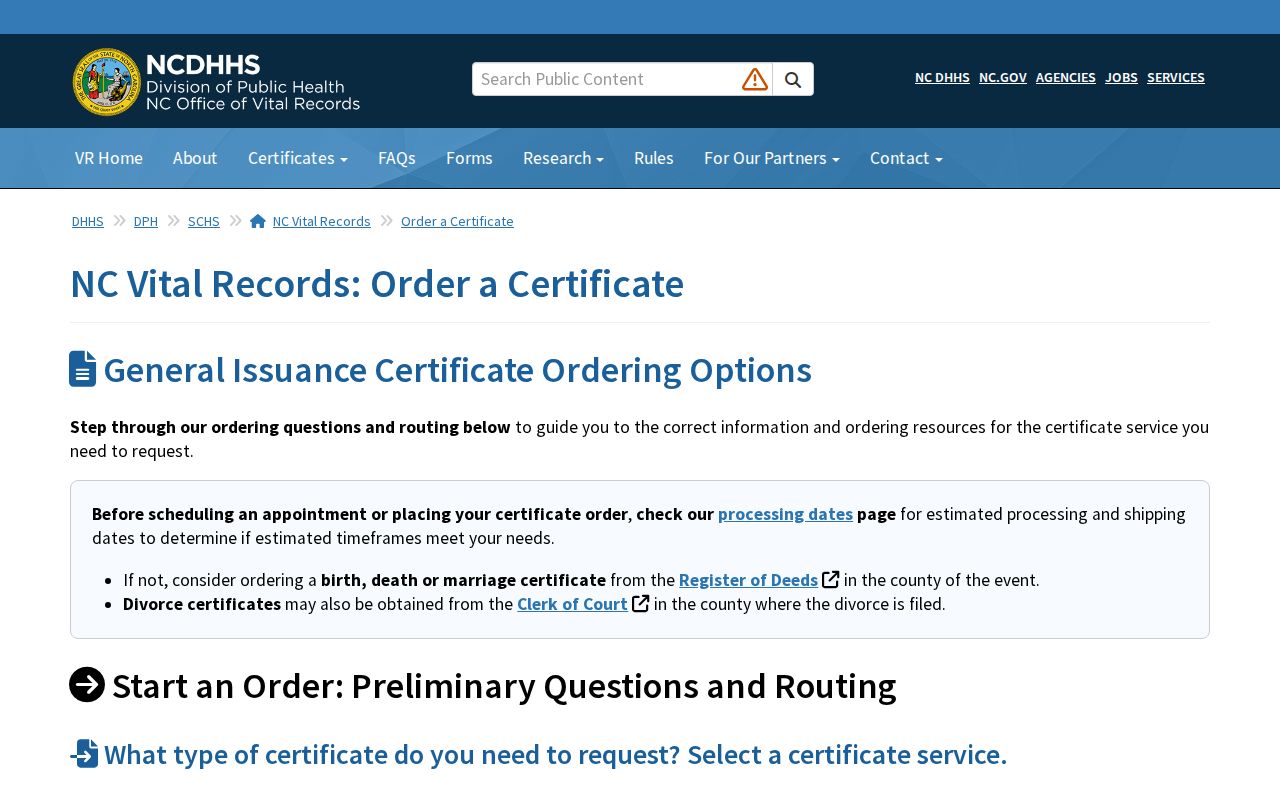
Its instructions distinguish an informational, uncertified copy from a certified copy. An uncertified copy is generally available with sufficient identifying information and the fee, subject to legal restrictions. A certified copy requires the relationship, legal-purpose, identification, or authorized status set by law.
The routine state search fee is $24 and includes one copy for each three-year period or portion searched. The research records a $15 additional-copy fee and expedite fees of $15 in state or $20 out of state under G.S. 130A-93.1. Confirm current payment, vendor, processing, and local-office details before submitting a request.
Note: Certified eligibility, fees, and processing procedures can change, so confirm current instructions with the issuing office before ordering.
Verifying a Gaston Resident Match
A reliable resident lookup uses two independent facts. For example, a parcel owner may be checked against the deed party named at the cited book and page. A voter result can be narrowed with a middle initial, age band, or district, then compared with a lawful court or historical record. Do not combine records merely because two names look similar.
When the question involves a deceased relative or an earlier resident, an obituary and probate file can establish a relationship trail. The library’s yearbooks and directories can anchor a former classmate in a past year, while a current contact should come through an institution, public business contact, or another consensual route.
- Write down the exact name, known town, date range, and the one fact already supported by a record.
- Use Gaston GIS for a plausible property connection, keeping the situs and tax mailing addresses separate.
- Search eCourts or the voter record with name variants, middle initials, suffixes, and a narrow date or county filter.
- Compare the party role, deed reference, family relationship, or other second feature before accepting a match.
- Request a copy from the actual custodian only when the record, format, and access rule are clear.
- Docket
- The court’s running case record, with its number, parties, filings, events, and outcome information.
- Index and image
- An index points to a record. The image is the underlying scanned document or page, which can have different availability.
- Certified copy
- A copy issued and attested by the custodian for a legally recognized use; access and fees may be restricted.
Note: A current tax owner, a voter registration, and a historical directory entry can describe different dates and should be labeled that way.
Gaston Voter Lookup Details
The state voter form requires first name and last name, lets the user add a middle initial and birth year, select Gaston County, and choose one or more statuses: Registered, Removed, or Denied. A returned record can include registration status, address, party, precinct, districts, and voter history. Voter history may show the election and voting method, not a person’s choices on a ballot.
G.S. 163-82.10 makes full date of birth, Social Security fragments, email, driver-license information, ID images, and protected addresses confidential. County is a registration jurisdiction, not a guarantee of a current residence. A protected voter can keep an address confidential with the qualifying protective-order or Address Confidentiality Program process.
The individual lookup is name-first. It is not a directory of all people at an address. Where a full file is genuinely needed for a lawful public-record purpose, use the Gaston voter-record request form and ask for a defined record rather than an open-ended compilation.
Gaston Resident Record Requests
When an online search stops, identify the custodian and request an existing record. The North Carolina Public Records Law, Chapter 132, provides inspection and copying rights under G.S. 132-1, 132-6, and 132-6.2. It does not require an agency to create a new database, assemble a broad biography, or disclose information made confidential by another law.
A useful request names the record type, person or address, approximate date, instrument or case number when known, and preferred format. The Register of Deeds can assist with older land material that is not digitized, the Clerk handles court files, Elections processes voter-file requests, and the library can point to directories and microfilm. North Carolina has no fixed statewide response deadline, but custodians must respond as promptly as possible.
For the voter-file form, requests are handled in the order received on Fridays and physical research, scanning, or copying may take up to two weeks. The form also identifies an election blackout from 10 days before early voting through 10 days after an election. Confirm actual preparation costs with Elections because the form does not state a fee.
Gaston Resident Lookup Privacy Limits
North Carolina opens many public records while closing specific fields. Chapter 132 does not override voter confidentiality, court sealing rules, or the Address Confidentiality Program. Recorded-document images can be subject to redaction requests for Social Security numbers and other protected identifiers under G.S. 132-1.10. Missing information may reflect a lawful privacy protection, not an error to work around.
The Address Confidentiality Program is administered by the North Carolina Department of Justice for eligible survivors using a substitute address. It does not erase every earlier record, but state and local agencies must use the substitute address in new public records subject to statutory exceptions. Corrections belong with the custodian: Elections for qualifying address protection, the Register of Deeds for eligible recorded-document redaction, Vital Records for amendment procedures, and the Clerk for court correction, seal, or expunction questions.
Lawful use. Use a Gaston resident lookup for a personal, lawful question and stop when that question is answered. Never use public information to stalk, harass, intimidate, or expose a protected person.