
Map Gaston Previous Residents by Era
Past residents leave different kinds of evidence in different eras. The current tax parcel is useful for the starting address and deed reference, but it is not a historical household list. A deed can carry the land chain back, while a directory or federal census can place people at an address in a particular period. Gaston sources have gaps and different geographic scopes, so select the closest source that actually covers the town, village, or route and the year in question.
| Source | Years It Covers | Where Held | What It Shows |
|---|---|---|---|
| GIS parcel and tax record | Current county data | Gaston Tax Mapping/GIS | Physical address, parcel/PIN, assessed owner, mailing address, deed and plat references. |
| Deed and mortgage indexes | 1846-1961 index coverage | Library and FamilySearch routes | Grantor and grantee paths into the recorded land trail. |
| Recorded deed books | 1847-1904 in the noted microfilm run; later access varies by series | Register of Deeds, microfilm, and research centers | Parties, instrument details, legal description, and prior references. |
| City directory runs | 1910-2013, with gaps and place-specific coverage | Gaston County Public Library, licensed databases, and selected digitized volumes | Dated address or householder clues for covered towns and villages. |
| Federal census | Decennial schedules under the 72-year public-release rule | Library databases and federal research routes | Household snapshots to pair with the closest directory. |
For a recent transfer, begin with GIS and the Register of Deeds. For a household question, select the closest directory volume before using the census. Note: A dated household listing is evidence for that year, not proof that the same people remained at the address afterward.
Start With a Gaston Parcel
Use Gaston GIS Search to capture the current primary property address, parcel number, PIN, current assessed owner, mailing address, deed book/page, plat book/page, and legal description. The house-history process begins with these details because an old street number may have changed, a parcel may have split, and a tax mailing address can be an office or PO Box. The detail panel also offers neighborhood name, year built, property use, acreage, city limits, and ETJ context.
The Gaston Library house-history guide joins GIS details to deeds, tax records, Sanborn Fire Insurance Maps, probate, newspapers, and microfilm.
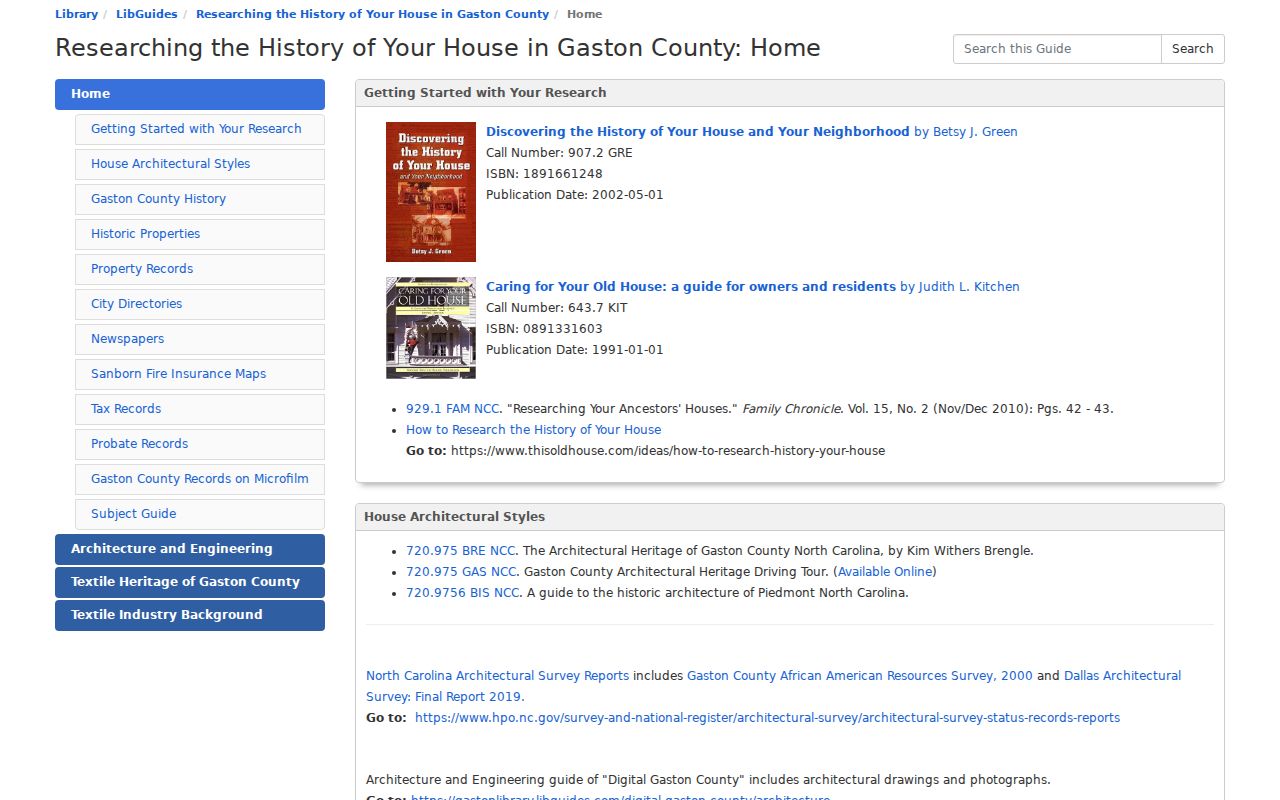
Its recommended sequence keeps each source in its proper role: the current map supplies the key, then deeds and dated historical records establish the earlier story.
Align Gaston Previous Resident Addresses
Address changes are the main reason a careful deed chain can look broken. Compare the lot and block, subdivision, plat book/page, parcel history, neighborhood clues, and the deed's legal description before deciding two street forms are unrelated. A physical address, postal label, tax mailing address, and legal description are separate keys. The current GIS map can reveal a split or merged parcel, but the recorded deed and plat are stronger evidence for land identity.
Historic labels create another Gaston trap. The directory guide says that 1940 Arkray Mills Village numbers should also be searched under Arkray, Bond, and Brown. No verified countywide renumbering year was found. Try the historic street or village label, preserve the spelling printed in that year's volume, and use the legal description to test the link.
Use Gaston House-History Sources
The library's house-history route broadens the search after deed work. It points to tax records, Sanborn Fire Insurance Maps, probate, newspapers, and microfilm as well as GIS and land records. A Sanborn map can describe a structure or its setting at the map's date. A GIS year-built field or permit may help date construction, but neither alone identifies the first household. Keep every date and source type visible in the research notes.
Probate can identify an estate, heir, property description, or notice address. The Gaston Gazette Microfilm Index, Footprints in Time, the Gaston County Historical Bulletin, and the Joseph H. Separk index offer paths to local notices. A notice is a lead to its source, not a substitute for an official record.
Trace Gaston Previous Residents in Deeds
The Register of Deeds portal has a Standard search with Last and Given name fields, Grantor, Grantee, or Either party selection, date limits, Search, and Reset. Its Advanced search supports firm or last name, first name, document types, book/page references, document number, date ranges, and similar-name or Soundex choices. The online index is a lead, not the official record. Confirm the image, book/page, or county copy, because the portal's terms warn that entries can be temporary.
- Use GIS to record the current owner and the deed book/page, plat reference, parcel/PIN, legal description, and physical address.
- Find or request the cited instrument in the Gaston Register of Deeds index. Record its grantor, grantee, recording date, document type, consideration when stated, legal description, and prior reference.
- Search that deed's seller or earlier owner as a grantee in the prior period. Compare the legal description before deciding it is the same tract.
- Repeat the handoff backward, noting every spelling, trustee, spouse, estate representative, lot number, and book/page.
- When the web trail ends, move to old index books, the Register of Deeds office, library microfilm, FamilySearch, and the North Carolina State Archives Gaston guide.
- Grantor and grantee
- The grantor transfers an interest and the grantee receives one. Either party may be a trustee, estate representative, business, or spouse rather than someone who lived at the address.
- Chain of title
- The documented sequence of instruments that links an interest in the same parcel backward through time.
- Legal description
- The lot, block, subdivision, or tract language in a deed or plat. It often survives an address change better than a street number.
- Criss-cross directory
- A historical directory arranged by street and number, useful for locating a listed householder in its publication period.
Pair Gaston Previous Residents by Year
City directories add the household layer that deeds cannot supply. Gaston holdings include Piedmont Directory Co. Gastonia runs from 1910-11 through 1927-28, a 1930-31 Miller's volume, Hill's Gastonia volumes for 1934, 1936, 1938, and 1940, later regional runs, and Greater Gastonia R.L. Polk volumes from 1998 through 2013. Earlier coverage is neither continuous nor countywide. A directory can be town, village, route, or business centered.
- Choose the closest directory that covers the address, mill village, or municipality.
- Record the name, street spelling, occupation or business notation, spouse notation, and any abbreviation from the street or alphabetical section.
- Check the next earlier and later volume for the same place, without treating a gap as proof of absence.
- Pair the directory with the closest released federal census, remembering the 72-year public-release rule.
- Use the deed or plat to test whether the directory's address form describes the same parcel.
The collections themselves are covered on the Gaston city directories page. Use that shelf to select the year, then return to the address trail with the printed wording intact.
Move Gaston Previous Residents to Lincoln
Gaston County formed from Lincoln County in 1846. A pre-1846 land question can belong in Lincoln County records or State Archives land-grant material, not a Gaston deed book. The library guide identifies state grants from 1845 to 1891, deed and mortgage indexes from 1846 to 1961, and recorded deed microfilm beginning in 1847 for the noted series. These are series dates, not a promise that every instrument or image is online.
Dallas was the county seat until Gastonia became the seat in 1911. Old directories, newspapers, and office references may therefore use Dallas, Gastonia, or a mill-village label. Preserve that jurisdiction choice beside the source so another person can reproduce the path.
Question Gaston Previous Resident Gaps
The documented 1874 courthouse fire matters when a historical series has a break. Research found State Archives accounts about courthouse repair after the fire, but no official inventory showing exactly which series were destroyed or recreated. A missing book, index entry, or address reference is therefore an archival question. Check surviving deed indexes, Clerk material, county accounts, library microfilm, and State Archives finding aids before deciding what the absence means.
Recordkeeping also changed when Gaston converted paper tax maps to GIS in 2002. The older BMP gave way to the six-digit Parcel ID and ten-digit PIN, while recorded deeds, plats, and surveys remained with the Register of Deeds. A current parcel screen is useful orientation, but it cannot replace the older paper or microfilm record.
Respect Gaston Past-Household Limits
Previous residents research has firm boundaries. A property owner may not have lived on the parcel. A directory can omit a household, lag a move, or use a village label. A mailing address can belong to an office, trustee, or PO Box. Public records also omit or protect some information, including protected voter addresses and Address Confidentiality Program participants. A historical absence is not a reason to combine unrelated sources into a claim about a person.
When an owner or listed household disappears from an address, an obituary, cemetery inquiry, or estate file can explain the next step. Keep the evidence in order: directory or census date, land-instrument date, obituary or probate endpoint, and the source reference. That protects against joining a transfer of land with a household move that happened years apart.
Lawful use. Use Gaston house-history records for personal research, family history, estate questions, and civic context. Do not use a past address trail to stalk, harass, or endanger a living person.