
Gaston City Directory Collections by Era
The Gaston Library city-directories guide is the starting shelf for historical directory research. Its coverage is not one continuous county list. It records publisher, volume, local places, library microfilm set or reel, and whether a licensed database also carries a volume. The North Carolina Collection at the Main Library is the main local access point. Ask for the exact town and year first, since a Gastonia entry, a mill-village listing, and a rural-route entry may appear in different runs.
Most early titles are selective. The library warns that years are missing and that the older books often center on a city, business district, mill, or route. The first directory described as covering the whole county was published in 1998. That boundary matters when a Gaston family lived outside Gastonia or moved between a mill community and an incorporated town.
| Collection | Years | Where held | Access |
|---|---|---|---|
| Piedmont Directory Co., Gastonia | 1910–11, 1913–14, 1918–19, 1921–22, 1923–24, 1927–28 | Main Library, Set 1 Reels 1–2 | Microfilm; selected years in Ancestry or HeritageQuest |
| Miller's Gastonia / Piedmont | 1930–31 | Main Library, Set 1 Reel 2 | Microfilm and licensed databases |
| Hill's Gastonia | 1934, 1936, 1938, 1940 | Main Library, Set 2 Reels 1–2 | Microfilm; selected databases; 1934 online at DigitalNC |
| Hill's Gastonia and nearby towns | 1942, 1945, 1947, 1949, 1951, 1953, 1954–55, 1956–61 | Main Library, Set 2 Reels 3–6 | Microfilm and licensed databases |
| Greater Gastonia R. L. Polk | 1998–99, 2000, 2001, July 2002–2013 | Main Library collection | Library collection; broad county and regional title |
Record the volume label exactly. A combined year or July issue is not interchangeable with a single calendar year, and a list of householders is not a census count.
Note: Directory coverage is printed-year and place-specific, so confirm the title page before treating a historical volume as countywide coverage.
Gaston Directory Years and Publishers
The collection has a usable publishing timeline. Piedmont issued the earliest listed Gastonia volumes from 1910–11 through 1927–28. Miller's followed with the 1930–31 Gastonia/Piedmont volume. Hill's then supplied the better-known 1934, 1936, 1938, and 1940 Gastonia books, later expanding through nearby-town and regional runs. The library also identifies separate Belmont, Cherryville, and Kings Mountain material, which prevents a researcher from treating every volume as a countywide title.
- 1910–28: Piedmont volumes document an early Gastonia and mill-centered environment.
- 1930–40: Miller's and Hill's volumes add Gastonia street, resident, business, and village detail.
- 1942–97: Later Hill and Polk runs broaden and change their town coverage over time.
- 1998–2013: Greater Gastonia becomes the first broad county or regional title named by the guide.
Coverage notes deserve as much attention as dates. The 1959 Gastonia material, for example, names Dallas, Flint villages, Groves, Lowell, Ranlo, Smyre, and West View Heights. Later titles can include Belmont, Cramerton, Mount Holly, Cherryville, Kings Mountain, and other areas, but each book needs its own check.
Mill Villages in Gaston Directory Volumes
Gaston historical research often turns on a village label rather than a city name. The 1934–40 directory coverage includes Arlington Heights, Arlington Mills, Armstrong Park, Chapel Park, Dixon, Flint, Gray, Groves, Love Heights, Osceola, Parkdale, Piedmont Spinning, Ruby, Seminole, Winget, Arkray, Mutual, Myrtle, and Victory. A person connected to one of those places may be easier to locate by the mill or village than by a modern municipal label.
The 1940 guide gives a practical address trap: Arkray Mills Village numbers were cross-referenced under Arkray, Bond, and Brown. Try each of those headings when a known household does not appear at the expected street name. This is historical indexing, not evidence that the labels are current boundaries.
For a modern parcel or street-by-street record trail, use the Gaston street directory after the historical address has been identified. The historical directory provides the older context; the county property records use a different set of address keys.
Search a 1934 Gaston City Directory
The digitized 1934 Gastonia directory at DigitalNC demonstrates why one book can answer several different questions. Its introduction identifies a buyers' guide, alphabetical resident and business entries, classified business pages, and householders arranged by street and number. Search a surname in the alphabetical portion. Use the householder section for a number and street. Use classified pages to locate a trade or business before looking for a named entry.
Digital access is useful for checking a page from home, but the library guide remains the better coverage map for the surrounding volumes and microfilm reels.
The Gaston Library directory guide shows the collection structure that supports the digitized book.
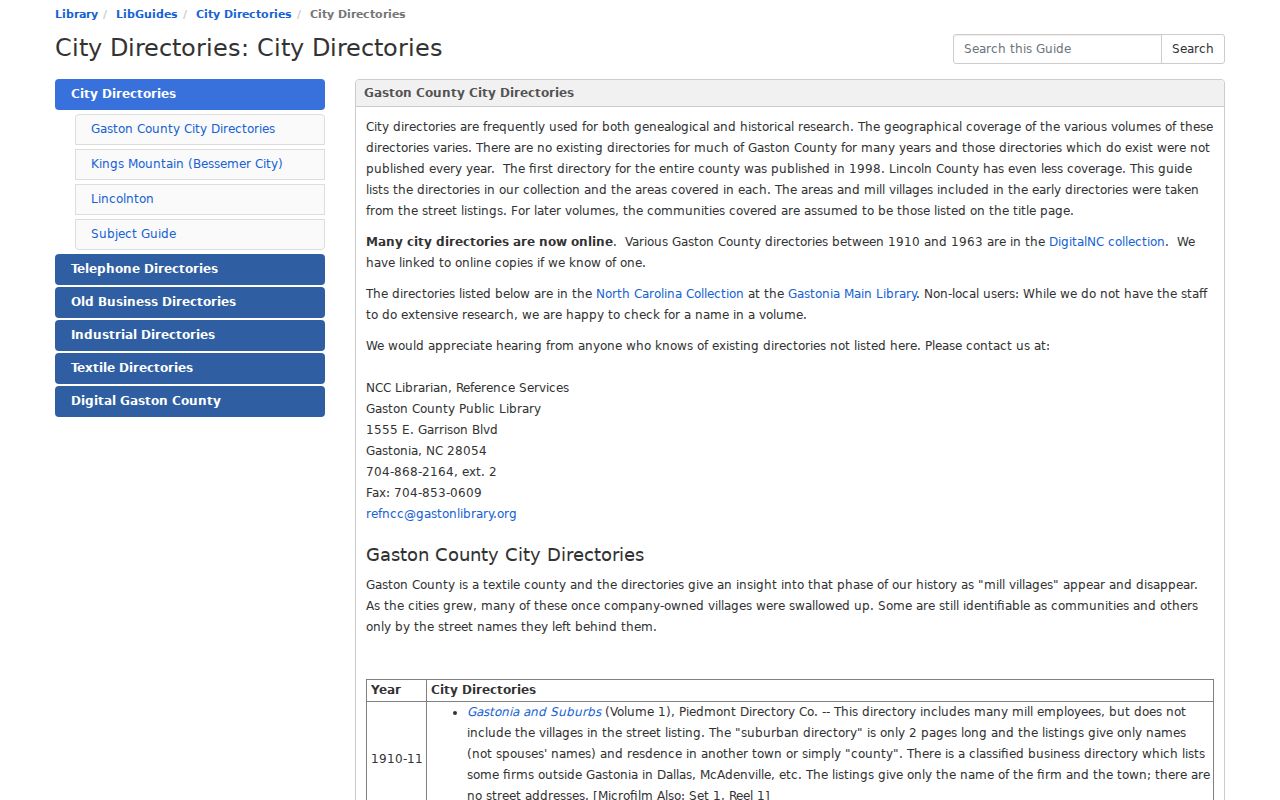
The guide's publisher and reel notes help select a volume before a library visit or a licensed-database search.
Read a Gaston City Directory Entry
A directory entry is a time-stamped clue, not present-day proof of residence. In the inspected 1934 model, usable details can include a person or household name, spouse or family notation, occupation or business, street address, and placement in a street-number sequence. Historical conventions may also identify a widow or use an owner or renter mark. Interpret a symbol only from the key in that particular volume.
| Entry field | What it can show |
|---|---|
| Name or household | Identifies the listed person or household; initials and spelling variants matter. |
| Spouse or family notation | May supply a relationship lead, including widow notation, but should be cross-checked. |
| Occupation or business | Connects the entry to a trade, employer, or classified listing in that volume. |
| Street address | Provides the historic address and can be checked in the householder-by-street section. |
| Editorial marks | Use the volume's own abbreviation key before assigning a meaning to a symbol. |
- Householder index
- A directory section arranged by street and street number, useful when an address is already known.
- Criss-cross directory
- A reverse arrangement that starts with an address or street rather than a surname, when a volume includes one.
- Abbreviation key
- The publisher's explanation of shortened words and symbols, usually placed in the front matter or directory notes.
Note: An entry can suggest a family link or historic address, but the cited source must be checked for its year and town.
Gaston Directory Access Points
The Gaston County Public Library's North Carolina Collection is at 1555 E Garrison Boulevard in Gastonia, and its listed phone number is 704-868-2164. The Local History and Genealogy resources connect the historical volumes with newspapers, cemetery research, census guidance, maps, yearbooks, textile heritage, and house-history material. Staff may sometimes check a name for a nonlocal researcher, though the library warns that staff time is limited.
Microfilm and licensed databases are access channels, not interchangeable copies. A selected year may be available through Ancestry or HeritageQuest, while another is held only as a reel. For eastern Gaston, the Mount Holly Historical Society research library also holds genealogy resources and Mount Holly News back issues from 1945 through 2005.
The Mount Holly Historical Society library page shows the eastern-Gaston history source that complements the county library’s broader directory shelf.
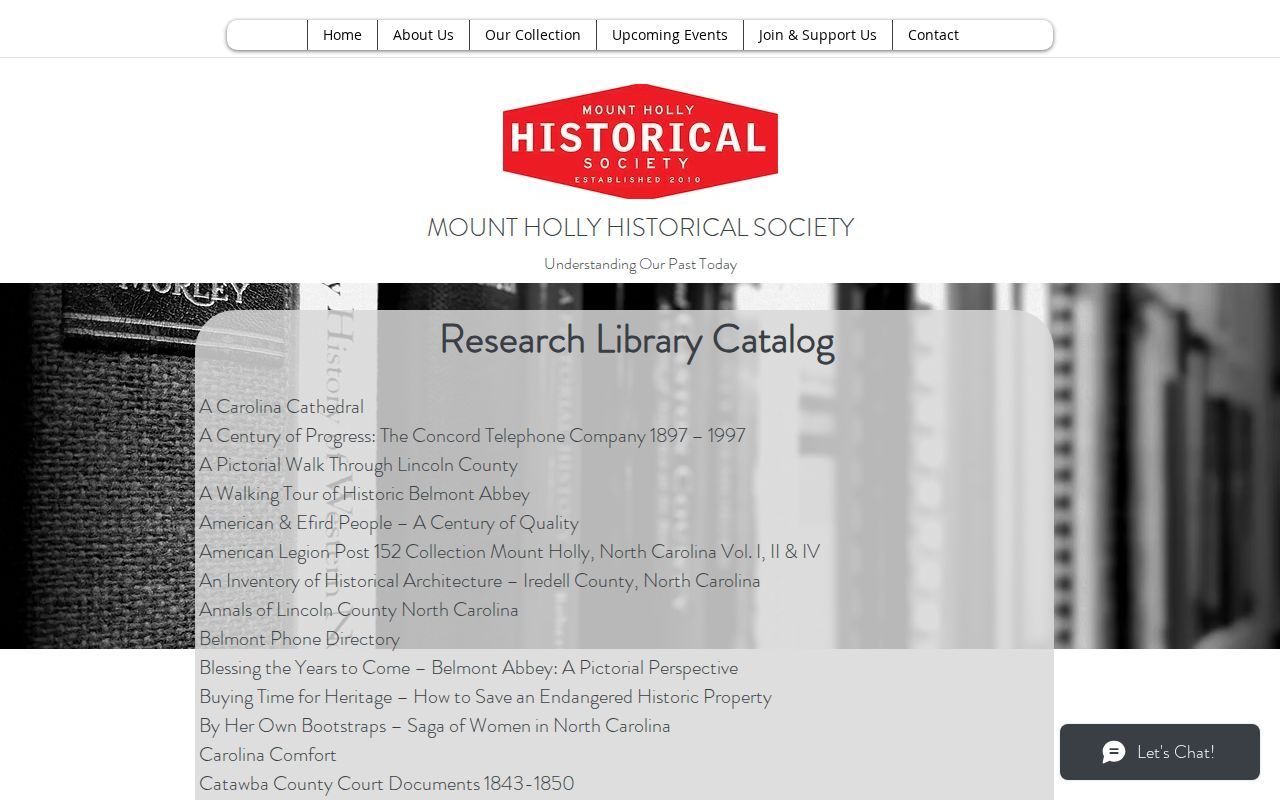
Its genealogy and newspaper holdings can supply a town, date, or surname lead before the search returns to a directory, microfilm reel, or custodian record.
Note: A precise request for a volume, reel, page, surname, and town gives library staff a practical way to check a limited historical collection.
Gaston Directory Coverage Beyond Gastonia
A Gastonia title cannot stand in for every Gaston community. The guide names Hill's Belmont for 1941, separate Cherryville and regional runs from 1962 onward, and Kings Mountain material for 1966 with selected earlier online supplements. Kings Mountain coverage can include nearby Bessemer City and Grover context, and not every area in such a volume lies within Gaston County.
The Greater Gastonia R. L. Polk books beginning in 1998 include Alexis, Belmont, Bessemer City, Cherryville, Cramerton, Dallas, Gastonia, High Shoals, Kings Mountain, and many other places. That wider title is valuable, but it does not repair missing earlier years. Pick the book that matches both the place and the time.
Newspapers, yearbooks, cemetery records, and the Joseph H. Separk index for Gastonia and Gaston County names from 1846–1949 can corroborate a directory lead. An index is a pointer to the source, not a substitute for the original record.
Trace Families in Gaston Directory Years
Use a repeatable household trail. Begin with the closest directory that actually covers the town. Record the printed volume year, exact street form, village label, occupation, spouse notation, and abbreviations. Then move one available volume backward and forward. A gap in the shelf is a gap in evidence, not permission to assume a move or death.
- Locate the surname or address in the nearest local volume and save the page reference.
- Check the prior and next available directory for the same town, recording changes rather than guessing their cause.
- Use the street or householder section when available to compare an address with nearby listed householders.
- Pair directory years with the 1930, 1940, 1950, 1960, and later federal census releases, observing the 72-year public-release rule.
- Use an obituary, cemetery inquiry, probate file, or newspaper index to test a disappearance from the directory.
A household can disappear because of a move, death, omitted coverage, altered street name, or changed publishing practice. Keep a source note for each possibility. A surviving entry becomes stronger when an independent record supplies the same town, family relationship, or address.
Gaston Directory Gaps and Archives
Gaston formed from Lincoln County in 1846, and the county seat moved from Dallas to Gastonia in 1911. Those changes can alter the office, place name, and record series that a family used. Pre-1846 land questions may belong in Lincoln County or State Archives work. A directory's town-centered coverage can also make a family appear absent when it was listed under a nearby municipality or mill village.
The State Archives' Gaston miscellaneous collection has 1847–1910 material such as citizenship files, bonds, chattel mortgages, child-labor papers, coroner inquests, accounts, and correspondence. The collection finding aid describes record groups rather than a complete online name index. The Gaston County Museum's research room offers another local-history route through yearbooks, photographs, correspondence, and mill material.
The documented 1874 courthouse fire is a reason to investigate a missing older source with care. A complete official list of destroyed or recreated series was not located, so an absent item is not proof that an event never occurred.